Baking Your First Sourdough Loaf: A Calm, Complete Walkthrough for Beginners
15 June 2026 · By Sourdough.mu · Updated 5 July 2026
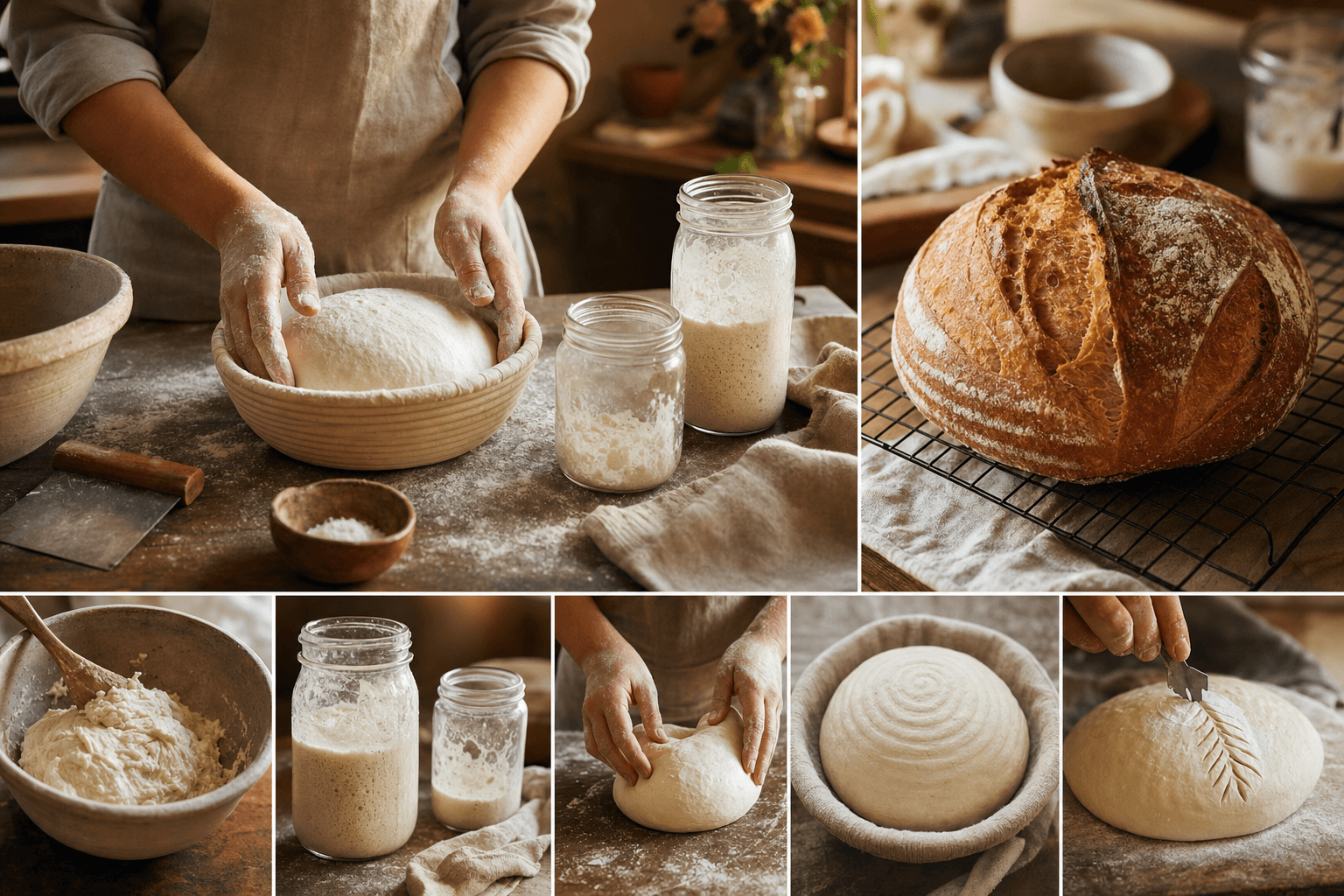
Sourdough has a reputation problem. Social media makes it look like a precision sport, all lattice scoring and ear obsession, and beginners conclude they need a decade of practice and a boutique Dutch oven before they can start. The truth is friendlier: flour, water, salt and a lively starter will make a genuinely good loaf on your first attempt, and every loaf after that teaches you something. This walkthrough assumes nothing except a working oven and an active starter.
What you need, and what you do not
Essential: a large bowl, a kitchen scale, a heavy pot with a lid or a baking tray, and your starter, fed and bubbly. A scale matters because cups measure flour badly.
Not essential: a banneton (use a bowl lined with a well floured tea towel), a lame (a sharp knife or clean razor blade scores fine), a stand mixer, special flour, or a proofing box. In a Mauritian kitchen the ambient warmth is your proofing box.
The recipe for one loaf: 500 g of flour, 350 g of water, 100 g of active starter, 10 g of salt. Ordinary supermarket bread flour works; if your flour feels weak, hold back 25 g of the water.
Mixing and the first rest
Dissolve the starter in the water, add the flour, and mix with your hand until no dry patches remain. It will look shaggy and unpromising. Cover the bowl and rest it for 30 to 60 minutes, then sprinkle the salt over the dough with a splash of water and squeeze it through until incorporated. This rest, called autolyse, lets the flour hydrate so the dough becomes workable without kneading.
Instead of kneading, you will do stretch and folds: with a wet hand, grab one side of the dough, stretch it up and fold it over the middle. Rotate the bowl and repeat four times. That is one set. Do a set every 30 minutes or so for the first two hours. Watch the transformation: the shaggy mess becomes smooth, elastic and alive.
Bulk fermentation: the step that decides everything
Now the dough rests, covered, while the culture works. This is bulk fermentation, and it is where most first loaves go right or wrong. In a warm Mauritian kitchen at 28 to 30 degrees, bulk can be done in as little as 3 to 4 hours from mixing, dramatically faster than the 6 to 10 hours recipes written for cold climates suggest. Ignore their clocks and read the dough instead:
- It has grown by roughly half, sometimes more.
- The surface is domed and slightly glossy, with a few bubbles visible.
- It jiggles when you shake the bowl and feels airy when you lift an edge.
Underproofed dough bakes into a dense loaf with a tight crumb. Overproofed dough spreads flat and smells boozy. Warm climates push you toward the second error, so check early and often.
Shaping and the overnight fridge trick
Tip the dough onto a lightly floured surface. Fold the edges into the centre like wrapping a parcel, flip it seam side down, and drag it gently toward you to build surface tension until you have a taut ball. Place it seam side up in your floured towel lined bowl.
Now the beginner's best friend: put the whole thing in the fridge overnight. Cold proofing slows fermentation to a crawl, deepens flavour, firms the dough so it is far easier to score, and, crucially, lets you bake at whatever time suits you tomorrow. In our climate the fridge is not optional luxury, it is the control knob.
Baking day
Put your pot, with its lid, into the oven and heat it at 230 degrees for a good 30 to 45 minutes. Take the dough straight from the fridge, turn it out onto baking paper, and score the top with one confident cut about a centimetre deep. Lower it into the hot pot, cover, and bake 20 minutes with the lid on, then 20 to 25 minutes with the lid off until deeply browned. Dark is flavour; pale is regret.
Then the hardest step: let it cool for at least an hour. A cut too early gives you gummy crumb, because the inside is still finishing its bake with residual steam.
Your first loaf will be imperfect, and that is the point
Maybe it will be a little dense, a little flat, scored crookedly. It will still be real bread, better than most of what money buys, made by you from three ingredients and a jar of wild microbes. Note what happened, adjust one thing next time, and bake again next weekend. Ten loaves from now you will be the person other people ask for advice.
Fermentation turns simple flour and water into food your gut understands. Explore the wider Healthspan health ecosystem.